

I have a pretty unique difficulty: I can’t concentrate very well, and neither can my dog, Bear. The difficulty extended to remembering to train and, ironically, hyper focusing so much on training that it was impossible to stop at a reasonable point. According to the CDC says 6.2 million children have been diagnosed with ADHD as of 2022, and according to Forbes, 66% of households have at least one pet, the majority of that percentage being dogs, as of this writing. Somewhere in this mix, the pets overlap with the ADHD families.
Despite the difficulties I still managed to find tricks that nobody else seemed to be talking about, and they were so simple! Why had nobody even discovered what I had discovered? Why was nobody talking about automating the dog training process by using a dog’s instincts and doing the training even in the middle of doing other tasks without full concentration being used? Well, I’m here to talk about it, and the tips and tricks I’ve had to learn myself. This can work for anyone, with or without ADHD.
- What is ADHD?
- Anytime is training time!
- Train Outside
- Be Patient
- Consistency is key for you and your pup
- Always reward yourself
- Conclusion
What is ADHD?
ADHD is a common neurodevelopmental disorder, often appearing in childhood, and can interfere with simple tasks such as learning, sitting still in a classroom or office environment, but can also interfere with daily life, even with treatment. If left untreated, a person with ADHD can develop depression and anxiety.
Dogs can actually help in a lot of ways. A 2015 study found that children who interacted with a dog became more attentive and improved their self-esteem and social skills. Even though many of these studies are done with children, there isn’t anything that says that these can’t be the case for adults as well. In fact, that’s why I started ADHDoggo.
Anytime is training time!
Humans aren’t supposed to have chaotic lives, not like we’ve created in the modern day. The 40-hour workweek is exhausting, and it can be hard for anyone to balance out work and family, and for those with mental disorders it is twice as exhausting. The thought of training your dog for even 5 minutes can seem exhausting.
It doesn’t have to be exhausting, however. On days that I knew I’d be busy doing chores or simply too exhausted to do anything I would stuff treats into my pockets, and I would train my dog on recalling the commands. Sometimes I would allow him to do things he naturally did, especially since he wasn’t getting the hang of the “down” command, so each time he laid down in the kitchen I would say “down. Good boy!” and reward him. I found that it worked with not only him but my mom’s dog as well. This also allowed me to do it randomly as I saw fit.
Your dog knowing a command when they see a treat is good, but it’s even better if they don’t know that treat is coming, and it doesn’t take a lot of time out of what you’re doing in the moment. These short interactions seem to be better for your pup vs an hour long training session.
My family also has a habit of using food to train as well. Ever since I could remember, my parents would tell their dogs to “sit” and “wait” as they prepared their kibble and “okay” was and is still our release command. When they get food should be scheduled twice a day just before or just after you eat. Your dog enjoys eating as much as you do and will provide the perfect training opportunity. If you have multiple dogs, even better as I find the younger dogs will look to the older dogs to see what they’re doing and will copy them.
Train Outside
If you’re someone who works out, your dog can be the perfect workout partner. Going for a run? I guarantee that your dog wants to join you. Going to a pet store? Bring your friend, and this is perfect for training too. As your dog gets better and better at commands without distractions, you’ll want to introduce other distractions. Start with simple commands in the front yard and make your way slowly around the neighborhood. It will be a slow walk throughout the week. No matter where your progress is, though, always remember that you did a good job with training.
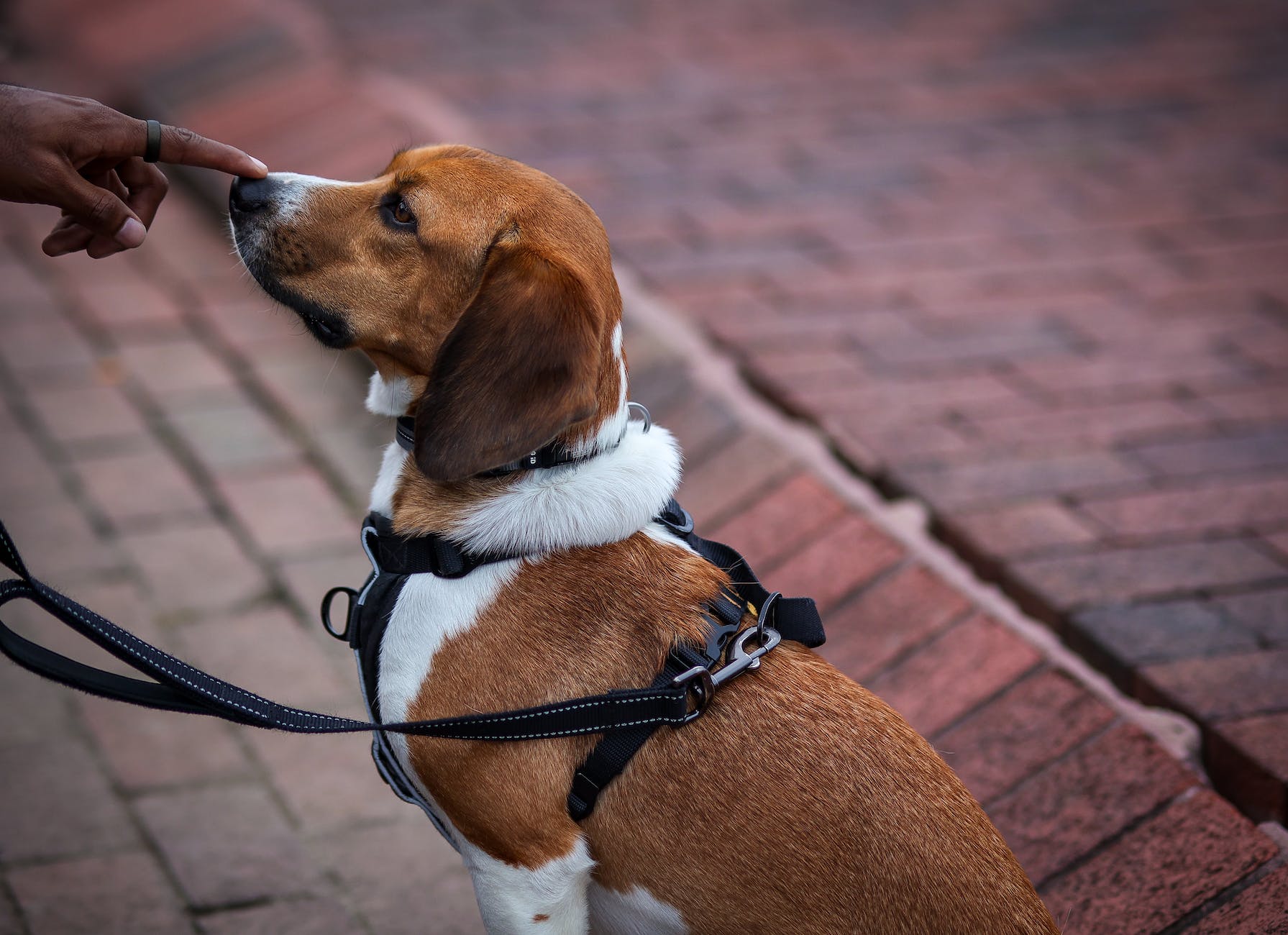
Taking your dog with you outside will also introduce new environments, new dogs for your dog to see, and it’ll increase their confidence. Take them outside when it’s dark (if it’s safe to do so!) for an added boost of confidence for those days you have to take them out late.
Be Patient
Patience isn’t really a word we with ADHD know, and American’s are losing patience with every generation. Everything is handed to us pretty quickly, but dog training takes time and effort. Just like humans learning new skills take time, but with the right training methods your pup will learn quickly.
Consistency is key for you and your pup
You don’t have to train at the same time every day, but you do have to keep your commands consistent. Dogs look for what you say as well as how you say it. You can’t say “sit” in a high-pitched voice one day and say it again in a stern tone the next, and you also can’t change the word you use for the command either.
In theory, you should be training your dog every day, but sometimes life gets in the way. We get home later than we meant to, or we can’t get off work until that big project is finished. That’s okay, it happens, but even as adults we still thrive off of schedules we control, especially if we have ADHD. Creating a day to set aside 5 minutes while you’re waiting for dinner to heat up can be the perfect way to get in a short training session of a few commands. I keep dog cookies in a jar in the kitchen and I’ll usually test my dog’s knowledge of “paw” (or shake) and stopping me from “scratching” myself (which I tend to do if I’m overly anxious) and by the time he gets the cookie my food is ready to eat.
Always Reward Yourself
No matter how badly you think you’re doing, always leave off on a positive note, and just look at how far you’ve come with your pup, no matter the age, and remember, you’re doing great. Look back at how far you’ve come often and then you’ll be able to see the progress you’ve made with your pup.
Conclusion
Living with ADHD doesn’t have to interfere with your dog’s training if you employ the tricks and tips I’ve employed in my own life, and this is something anyone can take advantage of, not just those with ADHD. By automating the process of training and keeping training as positive as you can, you’ll begin to notice a difference.
Have any tricks you’ve developed on your own? Share in the comments below! Happy training!

 ADHDoggo