
Golden retrievers are one of the most popular dog breeds, only ever being overshadowed by their other retriever counterpart, the Labrador Retriever. Coming in at around 20-24 inches and between 55-75 lbs, these highly energetic dogs are perfect for people who just want a loving and social companion.
Quick Breed Info
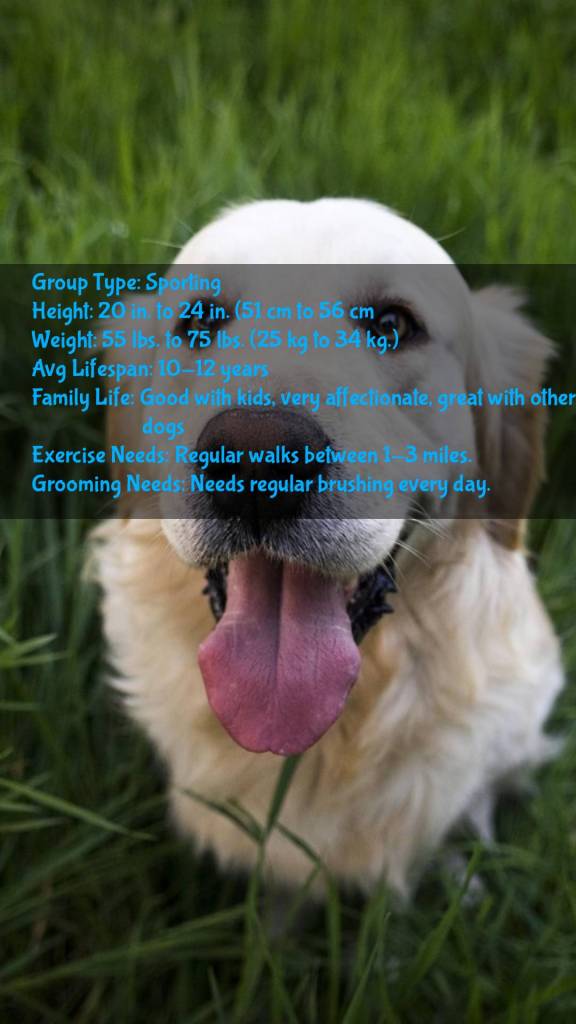
Breed Group: Sporting Group
Personality: Intelligent, friendly, affectionate
Height: 20-22 in (51-56 cm) for females, 22-24 in (56-61 cm) for males
Weight: 55-75 lbs. (25-34 kg)
Coat Type: Flat or wavy double coat that’s dense and water resistant
Color: Golden, Cream, Reddish
Life expectancy: 10-12 years
Grooming: Needs to be brushed every day
History
The earliest history we have on Golden Retrievers starts in the Scottish Highlands in the 19th century and was developed by Sir Dudley Marjoribanks. He bred a tweed water spaniel with a flat coated retriever; only the Flat-Coated Retriever is a dog breed we see today. Oddly enough, he chose a yellow-colored Flat-Coated Retriever dog, which is not a common color today as it is not considered a “breed standard color“. I will soon have a history of Flat-Coated Retrievers as part of the Breeds Series.
The pairing of the yellow Flat-Coated Retriever and the Tweed Water Spaniel created four yellow pups, one of whom would go on to be bred with a Red Irish Setter, which is why some Golden Retrievers have a reddish hue to them. Another pup went on to have puppies with a Flat-Coated Retriever, and one of their puppies was mated with a Labrador Retriever, and so the cycle continued.
A breed club for the Golden Retriever didn’t appear until 1911 and were called “The Yellow or Golden Retriever Club”, then underwent a name change to “Golden Retriever Club”, giving the name to the breed we know and love today. The breed would gain recognition by the American Kennel Club in 1932.
After World War I, Golden Retrievers gained popularity worldwide, and continues to be the third most popular dog breed.
Appearance
Golden Retrievers should be between 20 to 24 in. (51 to 61 cm), and they typically weigh between 55 to 75 lbs. (25 to 34 kilograms). They have “flags” on their front legs and butt and tail, which is a characteristic of all Golden Retrievers. Their coat is flat on top but becomes wavy toward the belly, and are often golden in color, though today we also breed white (called English Cream) and red as well. Some Golden Retrievers may even have a genetic trait that passes on white spots.
Temperament
Golden Retrievers are considered very intelligent, gentle, and affectionate. They are very eager to please, making them very easy to train and great for first time dog owners. Because of their gentle nature, they are incredibly tolerant of children, making them excellent family pets. They don’t have much of a prey drive either, making them excellent to be around cats and other small animals under supervision.
Beware of puppies that come from aggressive parents, as this trait is likely to be passed on due to genetic factors, rather than behavior.
Grooming Needs
Due to their double coat never shave them unless medically necessary. A double coat means your dog has two layers of coat called the topcoat, which is the part that lays flat on top of the second layer, called an undercoat. This undercoat is the part that sheds and leaves more hair on the floor than a woman does in her own shower. I have tested this myself, and I shed a lot of hair, but I’m still beat by my own golden retrievers. The undercoat is designed to grow back faster than the topcoat because the undercoat keeps them cool in the summer, which then sheds out during fall to make room for the much warmer winter undercoat, and the process starts over again in the spring. If you shave a Golden Retriever in the shortest possible (a #10 blade is often used by grooming staff) then you risk patchy, uneven coat that feels coarse and grainy to the touch rather than the soft, luscious, glossy texture of that topcoat. The undercoat can easily choke out the topcoat, which struggles to grow. However, sometimes a shave down is necessary either by the direction of your vet or due to severe matting.
To avoid severe matting, brushing is required with the use of a slicker brush and a greyhound comb, both of which can get that loose undercoat out, and the greyhound comb can easily find any mats before they become so severe that they require to be shaved out. Never cut out mats that your comb cannot bring out away from the skin, or else you risk cutting your dog.
Due to their floppy ears, regular ear cleaning is also a must, especially if you live in a wet climate or after your dog swims. Make sure you try out those ears with a towel every time you swim! These dogs are prone to ear infections! Take a cotton ball and soak it with a dog safe ear solution, then gently wipe the outside. Never go in the ear canal! Just like your own ear, you can risk damaging the ear drum or even pushing the wax further down.
Bathing can be done once every 1 to 3 months, but some Golden Retriever owners only bathe their dog twice a year. As a puppy, you should always get them groomed once a month, so they can become desensitized to the process, but any more than that can cause behavior issues in any dog breed and can ruin the special oils in their coat that keep them water resistant. For adult Golden Retrievers, I personally recommend every 3 months, as this keeps the shedding to a minimum and keeps their coat fresh without ruining the oils that keep them water resistant. I also recommend using a good dog friendly conditioner, as this is what will help the undercoat come out.
Health
There have been several studies done to pinpoint exactly what age Golden Retrievers are most likely to die, but the overall consensus is that they live around 10 years to 12 years on average.
This breed is generally considered healthy, but they are still prone to issues such as cancer, hypothyroidism, hip dysplasia, and arthritis, particularly as they get older.
Training
Unlike other retrievers, who are highly food motivated, your Golden Retriever may be less food motivated, as they are driven to please you. Petting or playing with their favorite toys can help replace treats. As puppies, treats are still the best way to motivate them. They are very easy to train.
Socializing them with other animals, including other dogs, is still a must. Expose them to many stressful situations. Sit, stay, come, drop-it, and place are a must for your dog to know, no matter the breed, but being retrievers, you can also teach a Golden Retriever to fetch a bottle of water or juice from the fridge.
Conclusion
Golden Retrievers truly earn their place as one of the world’s most beloved breeds. Their gentle temperaments, eagerness to please, and family-friendly personalities make them wonderful companions for both new and experienced dog owners. With the right grooming routine, proper training, and a little patience, they’ll reward you with a glossy coat, an enthusiastic tail wag, and a lifetime of love. If you’re looking for a loyal friend who brings sunshine into any home, a Golden Retriever might just be the perfect match..

 ADHDoggo